
Local SEO: How to Optimize Your Business for Local Search
- DigiMinds Solutions

- Feb 20
- 9 min read

Local visibility is no longer optional. If your business doesn’t appear when people search in your area, you’re not part of the decision set, no matter how strong your service is.
Local SEO is about earning that visibility. It’s how Google determines which businesses deserve to appear in the map pack, in localized organic results, and in “near me” searches. Proximity matters, but so do relevance, consistency, authority, and trust signals.
For startups and growing companies, this isn’t a branding exercise; it directly affects inquiries and revenue. Local search captures people who are already comparing options and preparing to take action.
If you’d like to revisit the broader mechanics of how search engines evaluate websites, you can start with our guide on SEO Fundamentals.
Local SEO builds on those same foundations, with stronger geographic and trust-based signals layered on top. Now, let’s look at how local SEO actually works, and how to set it up correctly.
1. What Is Local SEO Optimization?
Local SEO optimization is the process of improving your business’s visibility in geographically related search results. Unlike traditional SEO, which focuses on ranking nationally or globally, local SEO prioritizes:
Proximity (how close your business is to the searcher)
Relevance (how well your business matches the query)
Prominence (your authority and reputation)
When someone performs a local search, Google often displays results in the Map Pack, a highly visible section that includes business listings, ratings, contact details, and directions.
Local SEO optimization involves:
Creating and optimizing your business listings
Strengthening on-page and technical SEO signals
Building local authority through citations and reviews
Ensuring consistent brand data across the web
It is not separate from technical SEO or on-page SEO; it builds on them. A strong local presence depends on a technically sound website, optimized content, and structured data that reinforces your location signals.
2. Why Local SEO Matters for Startups and Growing Businesses
For startups and small businesses, marketing budgets are limited, and every channel has to justify its cost. Competing on broad, national keywords against established brands requires time, authority, and consistent investment. Most early-stage companies don’t have that luxury.
Local SEO creates a narrower, more strategic playing field. Instead of trying to rank everywhere, you focus on visibility within your actual service area, where intent is stronger and competition is more defined. When someone searches locally, they’re usually comparing options, checking reviews, and preparing to contact a provider. That makes local search one of the most conversion-driven channels available to growing businesses.
The Key Challenges Startups Face in Local Search
Local SEO is especially critical for businesses whose revenue depends on geographic visibility and trust.
This includes:
Businesses that rely on local awareness and discovery
Companies that need regional credibility
Service providers targeting a specific city or district
Brands building reputation within a defined community
It becomes particularly important for:
Foot-traffic businesses (retail stores, restaurants, clinics)
Service-area businesses (law firms, home services, agencies)
Appointment-based models (healthcare providers, consultants)
Businesses where regional trust directly impacts conversion
Startups typically face three structural challenges in local search:
1. Limited brand recognition
Established brands carry search demand and branded queries. Startups don’t. That means Google relies more heavily on structured signals, optimized profiles, consistent NAP data, reviews, and citations to determine legitimacy.
Example of a competitive local SERP:

2. Competitive local markets
In many cities, the Map Pack is crowded. Even niche industries can be saturated. Without a strong Google Business Profile, consistent listings, and local authority signals, it’s difficult to break into visible positions.

3. Trust and credibility gaps
Search engines measure reputation. A business with few reviews, inconsistent directory listings, or incomplete profile information sends weaker trust signals. For new companies, this credibility gap directly affects rankings.
Local SEO for startups is not just about appearing in search results. It supports:
Building local credibility
Generating qualified leads
Increasing local brand awareness
Converting high-intent searchers
For service-based businesses in particular, local visibility often translates directly into inquiries and revenue.


In local search, similar ratings are common. Review volume and recency often determine which business earns greater visibility and trust.
3. How to Create and Optimize Local SEO Successfully
Local SEO performance doesn’t begin with quick tactics or isolated tweaks; it begins with structure. Many businesses attempt to optimize before building the right foundation, which often leads to inconsistent visibility and underperformance in local results.
Sustainable local rankings require a clear sequence: first, create the right assets; second, optimize them strategically; third, strengthen authority signals; and finally, support everything with proper technical structure. When this order is followed, local SEO becomes a systematic growth channel rather than a collection of disconnected actions.
First Things First: Create Your Google Business Profile
If you don’t have a Google Business Profile, you don’t have a real local SEO presence.Your website alone is not enough to compete in the Map Pack.
Your Google Business Profile acts as your primary local authority signal. It tells Google:
Who you are
What you do
Where you operate
Whether you’re legitimate
Key Setup Steps
Enter your exact business name (avoid adding keywords).
Choose the most accurate primary category; this directly affects rankings.
Add your physical address or define your service area.
Insert your main phone number and website URL.
Complete verification (postcard, phone, or email).
Upload your logo and cover photo immediately.
Write a clear, professional business description.

Optimize Your Google Business Profile for Local Visibility
Creating your profile gives you presence. Optimization is what makes it competitive.
Once verified, your Google Business Profile should be fully expanded and actively managed:
Add relevant primary and secondary categories
Complete the Services section with clear, keyword-aligned descriptions
Write a concise and optimized business description
Upload high-quality, up-to-date photos
Enable messaging (if operationally suitable)
Use the Q&A section strategically to address common customer questions
Publish regular updates and posts
Optimization strengthens relevance, improves engagement signals, increases profile depth, and builds trust. Many startups stop after the initial setup, but in competitive local markets, consistent profile management is often what separates visible businesses from invisible ones.

Strengthen Local Authority with Citations & NAP Consistency
Your Google profile is not enough on its own. Search engines cross-reference your business information across the web.
If your Name, Address, and Phone number (NAP) differ across directories, trust weakens.
What You Need to Do
Audit existing listings
Fix inconsistent NAP information
Remove duplicate listings
Submit your business to high-authority directories
Ensure consistent formatting everywhere
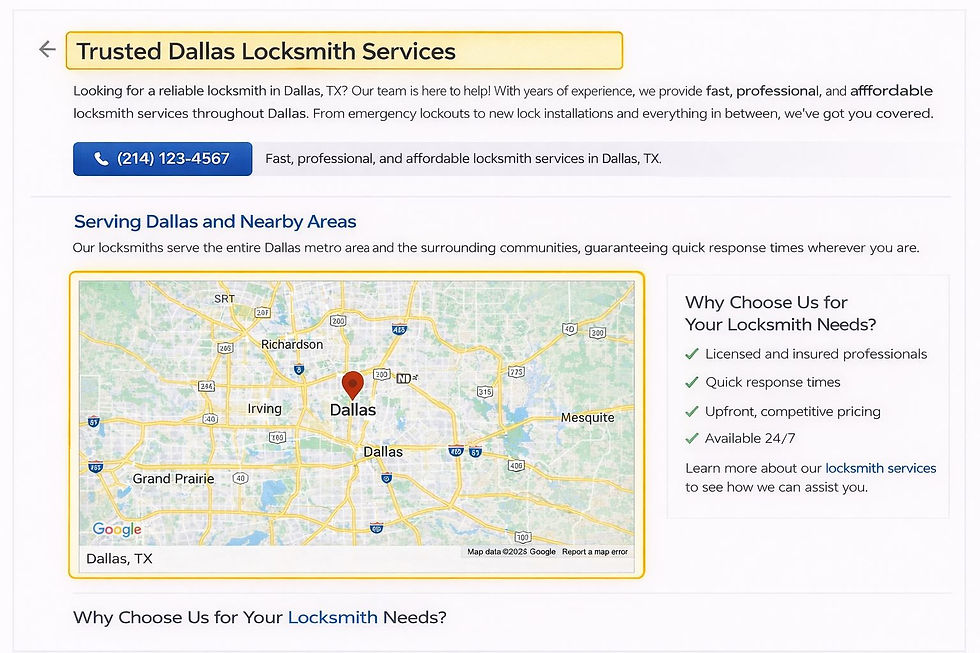
Build Location Pages That Support Local Rankings
Local visibility doesn’t rely on your Google Business Profile alone. Your website structure must reinforce geographic relevance. If search engines can’t clearly associate your services with specific locations, your ability to rank locally becomes limited.
If you serve multiple areas, you cannot rely on one generic service page.
Each location needs:
A unique H1 including the city name
Customized service content
Local references
Embedded Google Map
Internal links from main service pages
Local testimonials
Duplicate location pages dilute rankings. Each page must be meaningfully distinct and provide real, location-specific value.
Collect and Manage Reviews Strategically
Reviews are not just reputation markers; they directly influence local visibility and user behavior. In competitive markets, businesses with stronger review profiles consistently attract more clicks and build trust faster.
Reviews impact:
Local rankings
Click-through rates
Trust perception
Conversion rates
For startups, consistency matters more than sheer volume at the beginning. A steady flow of new reviews signals activity and credibility, even if the total count is still growing.
Best Practices
Request reviews immediately after service delivery
Share a direct review link to reduce friction
Respond to every review, positive or negative
Use relevant service keywords naturally in responses
Display selected reviews on your website
Without a structured review strategy, local SEO efforts remain incomplete.
Enhance Visibility with Structured Data & Schema Markup
Structured data helps search engines clearly understand your business information. While schema markup doesn’t directly “boost” rankings, it strengthens clarity, improves eligibility for rich results, and reinforces trust signals.
For local SEO, structured data helps connect your business name, address, services, and reviews, reducing ambiguity and strengthening geographic relevance.
Key Schema Types for Local SEO
LocalBusiness: Defines your business name, address, phone number, opening hours, and service area
Organization: Reinforces brand identity
Review: Highlights ratings and customer feedback
FAQ: Enhances visibility with expandable search results
The schema should be implemented in JSON-LD format and placed in the <head> section of your website. After implementation, validate it using Google’s Rich Results Test to ensure there are no errors.
Well-structured data improves how your business appears in search results and supports the authority signals you’re building through your profile, reviews, and website content.

4. Essential Tools for Effective Local SEO Optimization
Local SEO requires consistent monitoring, analysis, and refinement. The right tools help you track performance, identify gaps, and adjust strategy based on real data, but they don’t replace structured execution.
Tool | Primary Use in Local SEO | Why It Matters |
Google Search Console | Track local queries, impressions, clicks, and indexing status | Helps identify which location-based keywords drive visibility and where ranking gaps exist |
Google Analytics | Measure local traffic, user behavior, and conversions | Shows whether local visitors are converting into leads or inquiries |
Semrush | Local keyword research and competitor analysis | Reveals search volume, keyword difficulty, and competitor positioning in specific cities |
BrightLocal | Citation tracking and local ranking reports | Monitors NAP consistency, local pack rankings, and directory performance |
5. Common Local SEO Mistakes That Limit Growth
Many businesses invest time in local SEO but fail to see measurable results, not because the channel doesn’t work, but because execution is incomplete or inconsistent. Local search rewards structure, accuracy, and ongoing activity. When those elements are missing, growth stalls.
Common mistakes include:
Incomplete Google Business Profiles: Basic setup without full categories, services, photos, and activity limits visibility.
Inconsistent NAP Data: Mismatched business details across directories weaken trust signals.
Ignoring Reviews: Low volume, outdated feedback, or no responses reduce credibility.
Weak Mobile Performance: Slow or poorly structured mobile pages hurt engagement and conversions.
Missing Structured Data: Without a schema, search engines have less clarity about your business details.
No Location-Specific Content: Generic service pages cannot rank effectively for multiple cities.
Local SEO is not a one-time task. Sustainable growth requires ongoing optimization and active management.
6. Takeaways: Building Sustainable Local Visibility Through Strategic Local SEO Optimization
Local SEO success is not achieved by simply appearing on the map; it comes from owning visibility within a defined geographic market. Businesses need clarity around which locations they target, what local search intent looks like, and how competitors are positioned. Without that clarity, optimization efforts become scattered and inconsistent.
An effective local SEO framework connects multiple elements into one cohesive system. Google Business Profile management, localized landing pages, technical SEO health, citation consistency, and review activity must work together. When aligned, these signals build trust, authority, and stronger local ranking stability.
In execution, this means identifying priority service areas, structuring local pages strategically, maintaining accurate business information across directories, and continuously analyzing performance data. For growing companies, local SEO becomes more than a visibility tactic; it becomes a scalable growth channel that supports predictable, long-term local demand generation.
7. How DigiMinds Supports Startups and Small Businesses with Strategic Local SEO
DigiMinds approaches local SEO as a structured growth framework rather than a set of isolated optimizations. Instead of focusing solely on rankings, the goal is to build a sustainable local visibility system that connects search intent, geographic targeting, and conversion strategy from the start.
Through comprehensive local audits and data-driven implementation plans, foundational gaps are identified early. Technical SEO health, on-page localization, Google Business Profile optimization, and citation consistency are aligned within a clear structure. This ensures that visibility is not fragmented across platforms but reinforced through coordinated signals.
As businesses expand into new service areas, the framework scales with them. Performance tracking, structured reporting, and ongoing optimization keep efforts aligned with measurable outcomes. For startups and growing companies, local SEO becomes more than exposure; it becomes a predictable channel for qualified local demand and long-term market positioning.
8. FAQ
1. What is the difference between local SEO and traditional SEO?
Local SEO focuses on geographically relevant search results, while traditional SEO targets broader organic rankings. It prioritizes map visibility, local intent keywords, and proximity-based signals rather than nationwide reach.
2. How long does local SEO take to show results?
Most businesses begin to see measurable improvements within 3–6 months, depending on the competition and market maturity. However, foundational optimizations often start improving visibility and engagement metrics much earlier.
3. Is local SEO worth it for startups?
Yes. For service-based startups, local SEO often delivers higher ROI than broad national campaigns. It allows new businesses to compete in defined geographic areas with more targeted and cost-efficient strategies.
4. Can I rank locally without a physical office?
Yes, if you operate as a service-area business and optimize accordingly. Proper Google Business Profile configuration, localized content, and citation consistency are critical in this case.
9. Support & Contact
Local SEO services build the infrastructure for consistent local visibility, helping businesses appear in relevant geographic searches with clarity and authority. When supported by structured optimization, accurate citations, and ongoing performance analysis, local SEO becomes a long-term growth driver rather than a short-term ranking effort.
At DigiMinds, we provide strategic local SEO services tailored for startups and growing businesses competing in dynamic markets such as the USA and Europe. From comprehensive local audits and keyword mapping to Google Business Profile optimization and scalable implementation frameworks, our team builds systems that translate local search visibility into measurable business results.
Contact us via phone at +90 507 830 2127 or email at info@digimindssolutions.com.
References:


Comments