
Before diving into positioning and audience personas, it helps to have the basics in place. If you’re still shaping your brand, you might want to start with our earlier article, “Building a Strong Brand from Scratch: Step-by-Step Guide for Startups”.
Clear positioning is not something a business completes once and moves on from. It is a strategic decision that shapes how a brand grows, how its marketing performs, and how it is perceived over time. When positioning is unclear, teams tend to compensate with more tactics and more channels. When it is clear, growth becomes more focused and decisions become easier.
After market and competitor research, the next step is to define how you want to be perceived and who you are building your brand for. This is where brand positioning strategy and target audience research become essential. Together, they turn insight into direction.
In this guide, we explain what brand positioning and audience personas really mean, why they matter, and how to define them in a practical, evidence-based way.
1. What Is Brand Positioning and Audience Definition?
Brand positioning and defining your audience are two sides of the same coin, but they have different goals. Brand positioning strategy tells people what the brand means in the market, what it stands for, how it’s different, and why people should pay attention to it. Defining the audience makes it clear who the brand is for and whose needs should guide operational and strategic decisions.
Brand identity becomes clearer, messaging becomes more relevant, and marketing becomes more effective when these two things are in sync. A clear vision and mission help anchor that alignment by defining what the brand is here to achieve and why it exists. Even well-designed brands have a hard time getting people to recognize or trust them if they aren’t aligned.
Brand Positioning: Defining Your Place in the Market
Brand positioning is the intentional choice of how a brand wants to be understood relative to alternatives. It is not simply what a business does, but what people believe it represents and why they would choose it over others.
A strong brand positioning strategy is built on clarity rather than creativity alone. It answers a small set of critical questions: who the brand is for, what problem it exists to solve, what makes it meaningfully different, and what outcome it promises. When these answers are vague or interchangeable with competitors, positioning loses its power.
In practice, effective positioning reflects:
- The category the brand operates in and how it wants to be framed within it
- The primary audience and the context in which they make decisions
- A clear value promise supported by credible proof
- A deliberate choice about what the brand does not want to represent
Positioning is therefore not a slogan or a headline, but a strategic filter that shapes messaging, product decisions, partnerships, and internal priorities over time. For more on how this connects to your broader brand foundations, you can explore our guide on building a strong brand identity here: The Foundations of a Strong Brand Identity.
Target Audience and Buyer Personas: Understanding Who You Serve
While positioning defines what your brand stands for, audience definition, grounded in target audience research, clarifies who that promise is actually for. A target audience identifies the group most likely to benefit from and invest in your solution. Buyer personas go one level deeper by describing representative decision-makers within that audience and the context in which they operate.
To make this concrete, imagine you run a B2B SaaS platform that helps small logistics companies optimize route planning.
- Your target audience might be small and mid-sized logistics companies operating in urban areas in Europe.
- Your buyer persona might be an operations manager responsible for delivery efficiency, under pressure to reduce fuel costs and delays, and evaluated on cost savings and on-time performance.
This distinction becomes clearer when you look at real brands.
For example, HubSpot’s target audience is broadly small and mid-sized businesses looking to grow through inbound marketing and CRM. But within that audience, HubSpot speaks to very different personas: a marketing manager focused on lead generation, a sales leader concerned with pipeline visibility, and a founder who wants an integrated system without complexity. The brand stays the same, but the messaging shifts slightly depending on which persona is being addressed.

Both layers are essential. The target audience tells you who to focus on. The persona helps you understand how to speak to them, what they care about, what they fear, and what makes them trust a solution.
This is why personas are not just marketing tools. They shape product decisions, onboarding, pricing structure, and even customer support tone. When personas are grounded in real research, they reduce guesswork and align teams around the same understanding of the customer.
The Difference Between Market Segmentation, Target Audience, and Personas
Market segmentation, target audience definition, and persona development are often used interchangeably, but they describe different levels of strategic focus. Each serves a different purpose in building a focused and effective brand strategy.
Below is a simple comparison to clarify the differences:
| Concept | What it is | What question it answers | Example |
| Market Segmentation | Dividing the broader market into meaningful groups based on shared characteristics | “How is the market structured?” | Startups, scale-ups, and large enterprises |
| Target Audience | The specific segment or segments the brand chooses to prioritize | “Who are we focusing on?” | Startups and scale-ups in the US and Europe |
| Buyer Personas | Representative individuals within the target audience who influence decisions | “Who are the people we need to understand and influence?” | The founder focused on product-market fit, the Marketing Lead focused on demand generation, COO focused on operational clarity |
To make this concrete, imagine you run a branding and growth consultancy.
You might segment the market into startups, scale-ups, and large enterprises, then choose startups and scale-ups in the US and Europe as your primary focus. Within that audience, you define personas such as a founder seeking product–market fit, a marketing lead focused on demand generation, or a COO concerned with operational clarity.
Each level supports a different strategic decision. Problems arise when brands jump straight into personas without first choosing who they are actually for. This results in profiles that are interesting, but not useful, because they are not anchored to a clear business focus.
When segmentation, audience selection, and personas are aligned, teams gain clarity about who they serve, who they do not, and how to design communication and experiences that truly resonate.
2. Why Brand Positioning and Audience Clarity Are Critical for Business Growth
Brand positioning strategy and target audience clarity are not abstract branding concepts; they directly influence how efficiently a business can grow, how well marketing converts, and how consistently a brand is understood across markets.
When positioning is unclear, teams often compensate by producing more content, launching more campaigns, and testing more channels, but those efforts rarely compound. You might see short bursts of traction, yet the results are harder to repeat because the brand is not building recognizable meaning in the market.
When positioning and personas are defined with intention, they become a shared strategic framework across marketing, sales, and leadership. They reduce internal debate (“What should we say?” “Who exactly are we for?” “Why are we different?”) and replace it with a more consistent decision-making process. Over time, that consistency lowers acquisition costs, improves close rates, and strengthens brand trust, not because the brand is louder, but because it becomes clearer.
Creating Focus and Strategic Direction
Focus turns positioning into something teams can actually use. A clear brand position defines what the brand is here to do, who it serves best, and what it chooses not to compete on, which is especially important for growing businesses with limited time and resources. Instead of trying to speak to everyone, focus helps teams make clearer choices about what to prioritize, which opportunities to pursue, and how to build a brand that feels intentional rather than reactive.
A practical way to make focus operational is to use a short positioning “decision filter”:
- Primary audience: the segment we choose to serve first
- Category frame: what we want to be compared against
- Primary promise: the outcome we consistently deliver
- Proof: the evidence we can show, not just claim
- Non-goals: what we intentionally do not want to be known for
For example, Notion did not initially position itself as “a tool for everyone.” Early messaging emphasized replacing scattered docs and wikis with a flexible workspace, which supported clearer word-of-mouth and faster category recognition. That clarity helped users immediately understand when Notion was relevant to them and when it was not. It also made adoption easier because the product promise matched a very concrete, existing frustration rather than an abstract idea of “productivity.

Improving Marketing Effectiveness and Message Relevance
When positioning and personas are defined, marketing becomes more precise because the brand stops guessing what “should” resonate and starts communicating with language that matches real audience needs. Instead of producing generic copy that could fit any company, teams build messages around specific pains, triggers, and decision criteria. That shift changes not only engagement metrics but also the quality of conversations that follow.
Strong positioning also reduces the “content treadmill” problem. With clear angles and a defined audience, content planning becomes easier because topics connect to a consistent narrative rather than random weekly ideas. Campaigns perform better because they feel coherent across touchpoints, landing pages, ads, emails, and sales decks that reinforce the same promise instead of introducing a new identity each time.
| Persona | Primary pain/concern | Brand promise | Proof (evidence) | Call to action |
| Founder (early-stage) | Unsure about positioning and product–market fit | “We help you clarify what you stand for and who you are building for.” | Positioning workshop, market insight, early traction examples | “Book a strategy session” |
| Marketing Lead | Struggling with low conversion and generic messaging | “We turn audience insight into focused, relevant messaging.” | Persona research, messaging framework, improved conversion metrics | “See how we improve relevance” |
| COO / Operations Lead | Concerned about inefficiency and misalignment across teams | “We create alignment between strategy, identity, and execution.” | Cross-team workshops, brand frameworks, internal alignment tools | “Explore our process” |
| Growth Manager | Difficulty scaling without losing clarity | “We help brands scale without becoming generic.” | Case studies, market expansion frameworks, and consistency systems | “Talk to our team” |
Supporting Long-Term Brand Consistency and Market Differentiation
Consistency is what turns brand-building into a compounding asset rather than a series of isolated campaigns. Positioning defines the meaning layer of the brand, while personas define the human context the brand serves. When both are stable, the brand becomes recognizable, and recognition is a strategic advantage because it reduces perceived risk for buyers.
Market differentiation is rarely about having a unique service; many companies offer similar solutions. Differentiation stems from consistently delivering on a specific promise in the customer’s mind. Over time, that promise becomes the shortcut people use to understand the brand, and that is what protects you from price-based competition.
3. Understanding the Relationship Between Positioning, Audience, and Brand Identity
Positioning defines what a brand stands for, audience insight defines who that meaning is for, and brand identity is how both are expressed through design and language. When these three are aligned, a brand feels intentional and coherent; when they are not, even strong design can feel disconnected. That is why treating brand identity as only a visual exercise is a mistake without clear positioning and a defined audience; identity has no strategic anchor, and brands end up changing how they look instead of clarifying what they mean.
How Positioning Shapes Brand Perception
Positioning acts as the lens through which people interpret everything a brand does. The same design and message can have a completely different impact depending on how the brand is presented. If you position as premium, people interpret simplicity as confidence. If you position yourself as affordable, the same simplicity might be read as “basic” unless you manage that meaning carefully.
This is why positioning must be deliberate. It sets expectations before someone becomes a customer. When your experience aligns with those expectations, trust grows. When it doesn’t, credibility erodes, even if the actual service is good, because the brand promised one thing and delivered another.
Many early adopters tolerated Tesla’s early imperfections because the brand’s meaning was tied to innovation and category disruption. That positioning shaped expectations and perceptions long before customers evaluated details.
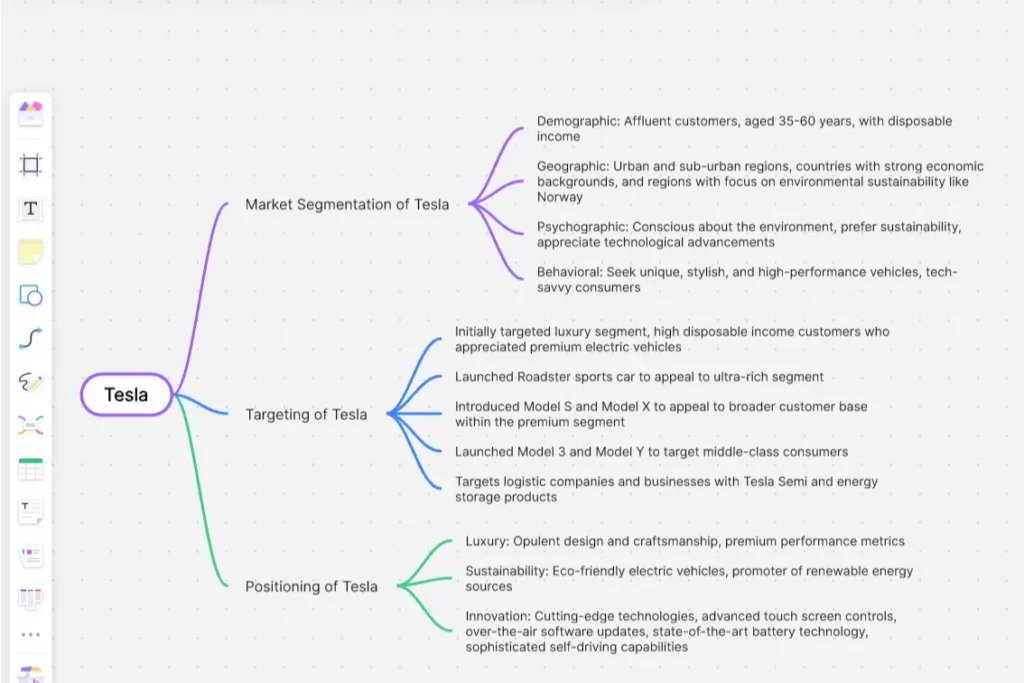
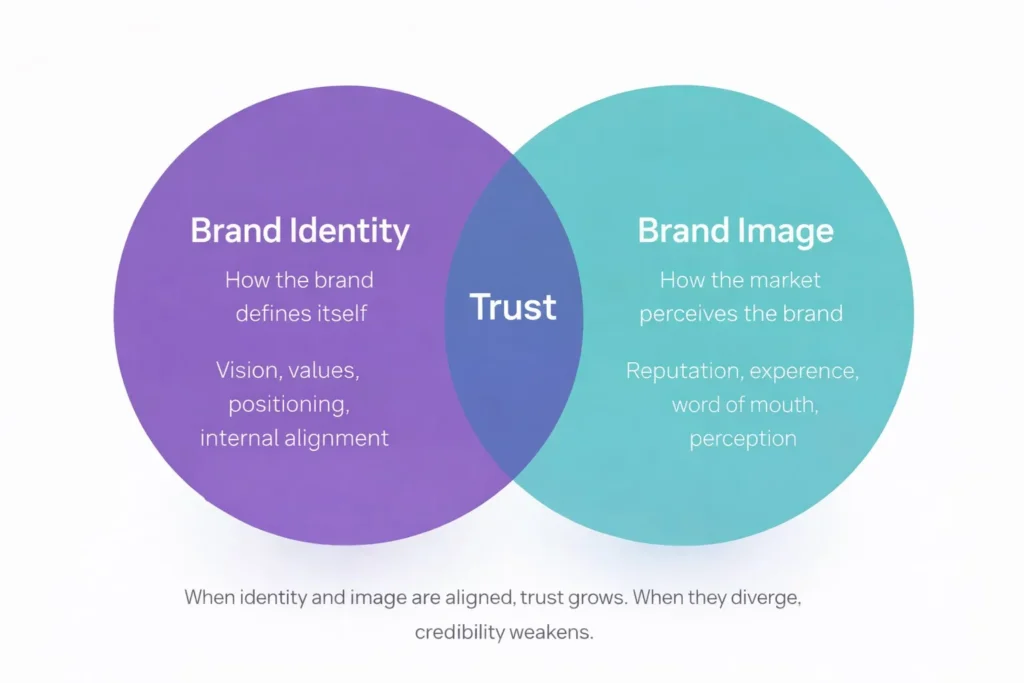
Brand Identity vs. Brand Image: Key Distinctions
Brand identity is what the business intentionally defines: its visuals, tone of voice, messaging framework, and brand guidelines.
Brand image is what people actually believe and remember after interacting with the brand, shaped by
marketing, product experience, customer service, reviews, and word of mouth. The gap between identity and image is where brands either build credibility or lose it.
Positioning and personas reduce this gap because they make identity more realistic and more consistent. When you know who you serve and what you can credibly promise, you are less likely to create an identity that over-promises or speaks to the wrong expectations. Over time, that alignment builds a stable reputation because people experience the same meaning repeatedly.
The Role of Audience Insight in Building a Strong Brand Identity
Audience insight ensures that identity resonates with real people rather than internal preferences. It shapes language choices, tone, visual cues, and even content structure based on what the audience finds credible and easy to understand.
For example, a technical buyer might value clarity and evidence, while a creative founder might respond better to vision and differentiation, and the identity should support that decision context.
This is also where localization becomes real. If a brand is serving multiple markets, audience insight helps avoid a one-size-fits-all identity that feels slightly “off” everywhere. The core identity can remain consistent, while examples, emphasis, and phrasing adapt to how decision-makers in each market interpret value.
For a deeper look at how competitive and market context shape these decisions, you can explore our related guide on competitor research and essential tools. “Creating Your Brand: Competitor Research & Essential Tools”
4. How to Define a Clear and Competitive Brand Position
Step-by-step: Building a brand positioning strategy
If you want positioning to be practical, you need a sequence your team can actually follow. A strong brand positioning strategy is not written in one sitting. It is built through choices, validated through evidence, and refined through repetition.
- Choose a clear segment to focus on first: Start with one primary audience you can win. If you try to position for everyone, your messaging becomes generic, and your proof becomes scattered.
- Define the category frame you want to be compared against: Decide what you want buyers to think you are. This shapes expectations before you even talk about your differentiators.
- Clarify the customer problem in their language: Use target audience research, call notes, and search behavior to capture how they describe the problem, not how you describe your service.
- Write your outcome-based promise: Positioning works best when the promise is about progress: what changes for the customer when they choose you.
- Identify your “why us” proof: Pick 2–3 proof points you can consistently show: process, expertise, results, frameworks, or case evidence.
- Add a non-goal to create sharpness: Define what you do not want to be known for. This single decision often improves clarity faster than adding more messaging.
- Turn the positioning into a repeatable message set: Create a small set of messaging pillars and examples that marketing, sales, and leadership can reuse consistently.
- Validate through performance and real conversations: Watch what converts, what objections repeat, and what segments respond best. Positioning evolves through evidence, not opinions.
Analyzing the Market and Competitive Landscape
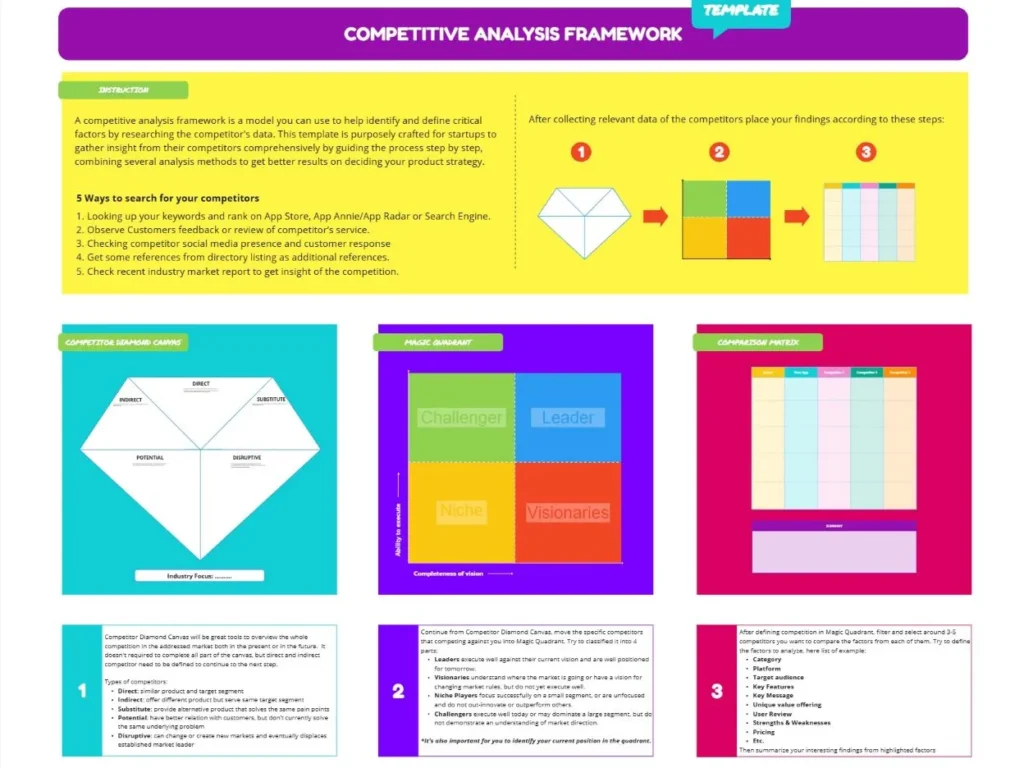
Competitive analysis is not just a feature comparison. It is an analysis of meaning: what competitors claim, what they emphasize, and what the market seems to reward. You are trying to understand category defaults so you can decide whether to align with them or deliberately diverge.
A useful approach is to review competitors across three layers: messaging, proof, and experience. Messaging shows what they claim. Proof shows whether they back it up. Experience shows whether customers actually feel it. This structure helps you identify opportunities that are both differentiated and credible, rather than “different” in ways the market does not care about.
Teams often evaluate competitors using criteria such as:
- Category framing (how they define what they are)
- Primary promise (the outcome they lead with)
- Differentiators (what they highlight as unique)
- Proof (case studies, metrics, customer logos, demos)
- Tone and style (premium, technical, founder-led, friendly, etc.)
Competitor Messaging Matrix
Identifying Your Unique Value Proposition
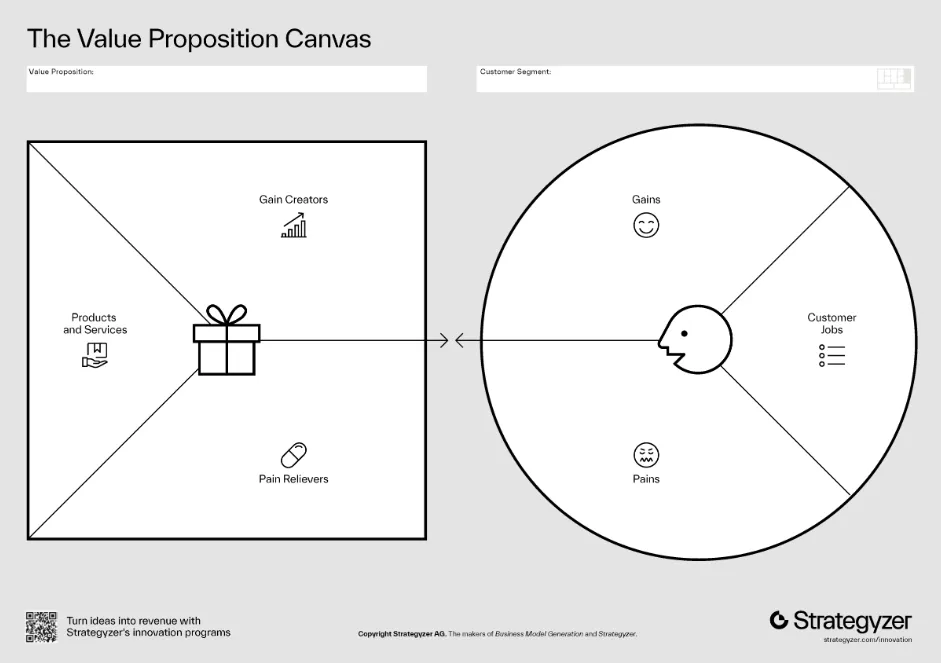
A value proposition explains what changes for the customer when they choose your brand and why that change matters. Strong value propositions are outcome-driven and specific, focusing on reducing risk, increasing meaningful results, or simplifying a complex job in a way that competitors do not. They also connect what you do to why it matters, which is where many brands struggle: they list services, but do not clearly define the result of those services.
This is where the Jobs To Be Done framework becomes useful. Instead of starting with your features or even your personas, JTBD asks what “job” the customer is trying to get done in a specific situation. The value proposition then becomes the promised progress: what improves in the customer’s life or business because your brand exists.
Credibility is the differentiator behind differentiation. A proposition is only defensible if you can support it with proof: process, expertise, results, or a clearly differentiated approach.
A practical pressure test is to ask whether a competitor could copy the same sentence today without changing their business. If yes, it is too generic; if no, you are closer to a strong position.
How to define a strong value proposition in practice:
- Describe the customer situation, not your service: Start with when and why the customer looks for a solution, not what you offer.
- Define the job they are trying to get done: What progress are they trying to make? What are they trying to avoid or achieve?
- Articulate the desired outcome in their language: Focus on the result (less risk, more clarity, faster execution), not the method.
- Identify what makes your approach meaningfully different: This could be process, focus, depth, specialization, or proof, not just features.
- List the proof that makes your promise credible: Case studies, metrics, experience, frameworks, or results that reduce perceived risk.
- Pressure-test your statement against competitors: Ask: could a competitor copy this without changing how they operate? If yes, refine it.
5. How to Conduct Effective Target Audience Research
Target audience research replaces assumptions with evidence. It reveals how people think, what they value, what triggers them to seek a solution, and what makes them trust one brand over another. Without research, personas become guesses and positioning becomes speculative, often reflecting how the company wants to be perceived rather than how buyers make decisions.
For brands serving multiple regions, research is even more important. The language buyers use, the proof they expect, and the pace at which decisions happen can differ across the US, EU, and TR markets. Research helps maintain a consistent strategic core while adapting messaging emphasis and examples to local expectations.
Key Data Sources for Understanding Your Audience
You do not need a large research budget to build meaningful audience insight. The key is to combine sources that reveal what people say with sources that reveal what they do. Even small datasets become powerful when you look for patterns across multiple sources and compare them consistently.
To understand your audience beyond assumptions, insight needs to come from real, observable behavior, not just internal opinions. Useful sources include:

Qualitative vs. Quantitative Audience Research
- Qualitative research explains the “why”: It uncovers motivations, fears, language, and context, the elements that shape how decisions are made.
- Quantitative research explains the “how much”: It shows scale, frequency, and priority across a wider group.
- Used together, they create personas that are both human and reliable: Qualitative gives depth, quantitative gives confidence.
Example:
- Interviews may reveal that founders fear wasting budget more than they fear slow growth.
- Analytics may show that this fear is most common among early-stage teams, while later-stage teams worry more about scalability and internal alignment.
- Together, this leads to clearer segmentation and more relevant messaging.
A practical way to combine both:
- Start with 5–10 interviews to surface themes
- Validate those themes with analytics and search behavior
- Refine personas based on what the data confirms
- Revisit and update them regularly
Turning Audience Insights Into Actionable Personas
Personas should translate insight into guidance. That means they should be written in a way that helps teams make decisions, not just understand people. A persona becomes actionable when it clarifies what the person values, what they fear, what triggers action, and what proof removes doubt.
To keep personas usable, connect each persona to messaging and execution. Include common objections and the type of proof that addresses them. Clarify the decision journey: what research happens first, who influences the decision, and what the final “yes” depends on. When personas include decision context, they become a shared tool across teams rather than a document that is referenced once and forgotten.
6. How to Build Practical and Useful Audience Personas
Personas exist to explain behavior, not to describe people. They are useful when they reflect real decision contexts, constraints, incentives, trade-offs, and what failure looks like. A persona that says “likes innovation” adds little value. A persona that says “needs proof within 30 days because runway is limited” changes how you communicate, what you prioritize, and how you structure your offer.
For startups and small businesses, personas are shaped less by demographics and more by operational pressure: time, budget, team size, urgency, and the consequences of a wrong decision. That is why persona work should focus on accountability, risk, and decision criteria. When these elements are captured well, messaging becomes sharper, and the brand feels more trustworthy because it reflects the buyer’s reality.
In practice, teams can use simple tools to structure this work. For example, HubSpot’s Make My Persona helps turn interviews into clear persona profiles, while UXPressia connects personas to journeys, pain points, and touchpoints across the experience. These tools are most useful when they support real insight rather than replace it.
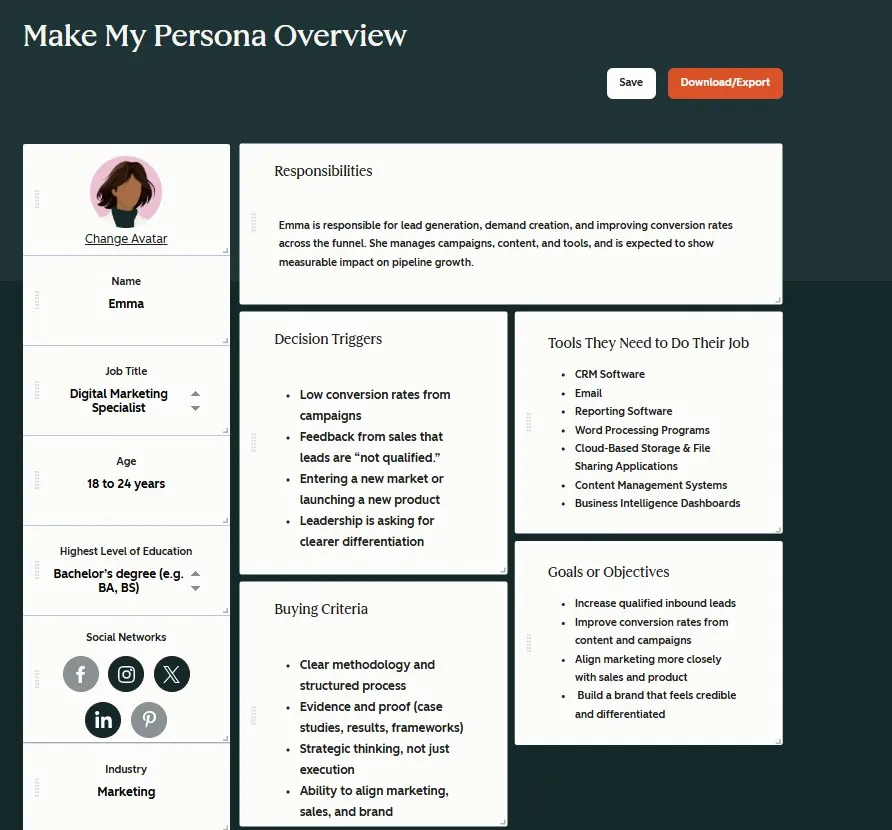
What a Strong Buyer Persona Includes
A strong buyer persona includes enough detail to guide messaging, offer design, and channel choices without becoming a biography. It should be specific, but not so narrow that it becomes unusable.
A practical buyer persona typically includes:
- Role and responsibilities (what they do daily)
- Primary goals (what success looks like to them)
- Key constraints (time, budget, team capacity, internal approval)
- Decision triggers (what makes them start searching)
- Objections (what makes them hesitate)
- Proof needs (what convinces them: case studies, metrics, demos, references)
- Preferred channels (where they research and who they trust)
After listing these, add a short section: “How to speak to this persona.” This keeps personas usable for content, ads, and sales.
Validating Personas With Real Data and Feedback
Validation prevents personas from becoming outdated or wishful. Even well-researched personas can drift over time as the business changes or as new markets behave differently. That is why validation should be treated as an ongoing loop, not a one-time phase.
Validation can be lightweight. Review call notes monthly, compare persona assumptions against analytics behavior, and ask sales and customer success teams whether objections and triggers match reality. When you find repeated mismatches, update the persona. This keeps the strategy anchored in real conversations rather than internal belief.
A simple validation checklist is:
- Are our top objections still the same this quarter?
- Do our best-performing pages match our persona intent?
- Are deals stalling at the same decision point?
- Is one market behaving differently from another?
Using Personas Across Marketing, Sales, and Product Teams
Personas create the most value when they are shared across teams. Marketing uses personas to write and target. Sales uses them to qualify and handle objections. Product uses them to prioritize features and onboarding clarity. Leadership uses them to decide where to invest.
To make that happen, personas must be operationalized. That might mean embedding them into campaign briefs, sales scripts, onboarding flows, or content guidelines. When personas stay theoretical, teams default back to generic messaging. When personas are used consistently, the brand sounds sharper and more aligned, even across different channels and team members.
7. Using Research and Data to Shape Brand Positioning Strategy
Research and data ensure that a brand positioning strategy is grounded in reality rather than aspiration. They provide evidence for strategic choices and reduce the risk of building positioning on internal assumptions alone. This does not mean brands should follow data blindly; it means they should use data to confirm what the market values and what audiences respond to.
In practice, data makes a brand positioning strategy stronger because it helps teams commit. When you can see which messages convert, which pages retain attention, and which objections repeatedly appear, it becomes easier to choose a focused direction and defend it internally.
Connecting Market Data With Strategic Decisions
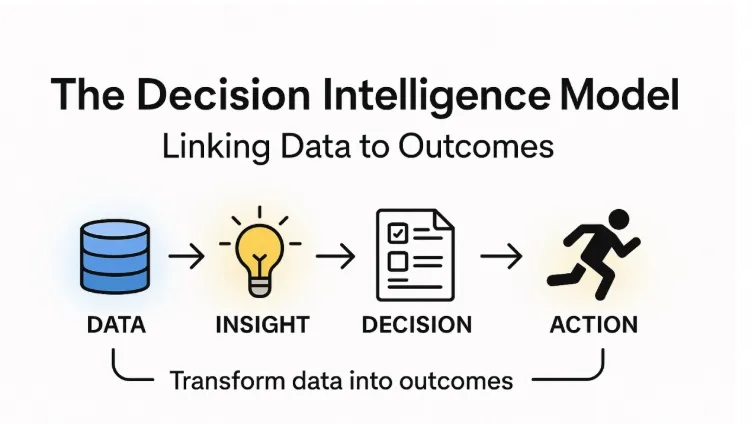
Data should influence what a brand chooses to prioritize within its brand positioning strategy. It should inform which segments to focus on, which messages resonate most, and which differentiators matter in practice rather than in theory. The key is translating numbers into decisions, not just reporting them.
For example, if analytics show that one segment consistently converts at a higher rate and has lower churn, that may justify prioritizing messaging and offer development around that segment. If competitor analysis shows that most brands claim “full service” but few provide measurable proof, that may create an opportunity to position around a structured approach and evidence-based outcomes.
Aligning Brand Messaging With Audience Needs and Expectations
When messaging reflects real audience needs and language, it becomes easier for people to understand the value of a brand and trust its promises. Alignment is not just a copywriting improvement; it is a trust improvement. People trust brands that sound like they understand the problem without exaggeration.
This is also where persona accuracy matters. If your persona values speed and clarity, messaging should emphasize deliverables, timelines, and proof. If your persona values strategic confidence, messaging should emphasize frameworks, research, and long-term consistency. Over time, that alignment creates coherence across content, sales communication, and brand identity.
8. Takeaways: Building a Clear Market Position and Audience Focus for Sustainable Growth
Clear positioning and research-driven personas create focus, relevance, and consistency. They reduce wasted effort by helping teams invest in fewer messages with greater confidence, rather than spreading attention across multiple directions. Over time, this focus improves performance because the market begins to associate the brand with a clear promise and a consistent kind of value, which is exactly why many brands turn to a brand identity agency in USA & Europe or a professional branding company USA & Europe when they reach a stage where clarity matters more than experimentation.
The most effective positioning strategies are grounded in real market insight and supported by credible proof. The most useful personas are built from real research and validated through ongoing feedback. When these elements are aligned with brand identity, teams communicate more clearly, and customers experience a more coherent brand across every touchpoint a level of consistency that is difficult to achieve without the structured thinking and cross-market perspective a professional branding company USA & Europe typically brings.
For brands scaling across markets, this foundation matters even more. It provides a stable core that can adapt in execution without losing meaning. That is what turns branding into a long-term growth asset rather than a one-time project, and why working with a brand identity agency in USA & Europe can be less about “design” and more about building a durable, scalable system for growth.
9. How DigiMinds Supports Brands in Defining Position and Audience Personas
DigiMinds supports businesses in building a clear and focused brand positioning strategy by guiding them through every stage of defining their market position and understanding their target audience through structured target audience research. This process is designed to help brands not only articulate how they want to be perceived, but also translate that perception into structured strategies that support consistent communication and sustainable growth.
By combining strategic thinking with research-driven insight, DigiMinds helps brands align their internal goals with real market expectations using a disciplined approach to brand positioning strategy and target audience research. This alignment creates stronger positioning, clearer messaging, and a more coherent brand experience across all touchpoints.
Strategic Brand Discovery and Positioning
DigiMinds begins with a strategic discovery process that explores the core of the business, including its goals, competitive context, and long-term ambitions. This phase focuses on understanding how the brand currently operates in the market, how it is perceived, and where meaningful opportunities for differentiation exist.
Based on these insights, DigiMinds works with brands to define or refine their positioning with clarity and focus. The goal is to ensure that the brand’s position is not only conceptually strong but also relevant, credible, and aligned with the realities of the market.
Target Audience Research and Persona Development
Once the brand’s position is clarified, DigiMinds supports businesses in developing a deep understanding of their target audience. This includes conducting structured target audience research and translating insights into practical buyer personas that reflect how real people think, decide, and evaluate options.
These personas help teams across marketing, sales, and product align around a shared understanding of the customer. This ensures that communication is more relevant, experiences are more consistent, and strategic decisions are grounded in real audience needs rather than assumptions.
A Professional Branding Company Supporting Growth
DigiMinds supports growing brands with strategic clarity that scales across markets and stages. This includes translating positioning and personas into messaging frameworks, identity direction, and practical guidelines that teams can use consistently over time.
For businesses expanding across regions, the goal is to maintain a stable core promise while adapting examples, emphasis, and proof to local expectations. This approach helps brands grow without losing coherence, which is often the difference between short-term traction and long-term brand equity.
10. FAQ
Below are some of the most frequently asked questions about brand positioning and audience personas. This section is designed to clarify common points of confusion and provide practical answers that help businesses apply these concepts with confidence.
1. What is the difference between brand positioning and brand identity?
Brand positioning is the strategic meaning you want to own in the market, who you serve, what you stand for, and why you matter. A brand positioning strategy defines this direction. Brand identity is how that strategy becomes visible through visuals, tone of voice, and experience. This is why many brands work with a brand identity agency in USA & Europe or a professional branding company USA & Europe to ensure their identity reflects a clear strategic core rather than just good design.
2. What is the difference between a target audience and buyer personas?
A target audience is the broader group you aim to reach, while buyer personas represent typical decision-makers within that group and how they evaluate choices. Target audience answers “who is this for,” and personas answer “how do they decide.” Both are built through structured target audience research and together make messaging more relevant and precise.
3. Can brand positioning and personas change over time?
Yes, but changes should be intentional and based on evidence, not trends. A brand positioning strategy evolves when your offer, market, or growth stage changes. Personas evolve as decision-makers and priorities shift. Updates should be driven by sales insight, performance data, and ongoing target audience research.
4. How many buyer personas should a business define?
Most businesses start with two to four personas, enough to reflect meaningful differences without making the strategy hard to use. Too many personas reduce clarity and adoption. A small, focused set is easier to apply and refine over time.
11. Support & Contact
Defining a clear brand position strategy and understanding your audience are strategic steps that help businesses build strong foundations, communicate with clarity, and support sustainable growth. When positioning and personas are aligned, brands are better equipped to make confident decisions, connect with their audiences, and maintain consistency as they scale across markets.
DigiMinds supports businesses at every stage of defining and refining their positioning and audience understanding. Through strategic discovery, research-driven insight, and structured frameworks, DigiMinds helps brands turn abstract ideas into clear, actionable strategies that teams can apply across messaging, identity, and brand touchpoints.
With DigiMinds, you don’t just gain a branding partner; you gain a team committed to helping your brand grow with clarity, focus, and long-term direction.
Contact us via phone at +90 507 830 2127 or email at info@digimindssolutions.com.
References:
- HubSpot: https://blog.hubspot.com/agency/develop-brand-identity
- HubSpot: https://www.hubspot.com/make-my-persona
- Mailchimp: https://mailchimp.com/resources/visual-branding-and-storytelling/
- Micro: https://miro.com/templates/community/
- LinkedIn: https://www.linkedin.com/pulse/decision-analysis-model-how-smart-organisations-link-data-vikas-mehta-7ggjc/
- Boardmix: https://boardmix.com/flow-chart/
- Investopedia: https://www.investopedia.com/terms/b/brand-identity.asp
- UXPressia: https://uxpressia.com/personas-online-tool