
How to Choose the Right Keywords for Your Business
- DigiMinds Solutions

- Mar 11
- 10 min read

Growing a website’s visibility on search engines rarely happens by accident. Behind most successful SEO strategies lies one fundamental process: choosing the right keywords.
Keywords are the bridge between what people search for and the content businesses create to meet those needs. When a company targets the right search terms, it becomes easier for potential customers to discover its products, services, or insights through search engines.
However, for many startups and small businesses, keyword research can initially feel confusing. Questions like “Which keywords should we target?” or “Will this keyword actually bring customers?” are very common.
The good news is that keyword research doesn’t have to be complicated. Once you understand how search works, you can approach it more strategically and identify opportunities that align with your business goals.
In this beginner-friendly guide, we’ll explain what keyword research means, how search engines use keywords to rank pages, and how to choose the right keywords for your business step by step.
1. What Is Keyword Research?
Keyword research is the process of discovering the words and phrases people type into search engines like Google when they are looking for information, products, or services. It helps businesses understand how their potential customers search online and what type of content they expect to find.
For example, someone trying to improve their website traffic might search for terms such as “how to choose keywords,” “SEO keyword research guide,” or “keyword research for beginners.” Each of these searches reflects a real question or need that a user wants to solve.
When businesses create helpful and relevant content around these searches, they increase their chances of appearing in search results and attracting the right audience to their website. Over time, this can help build consistent organic traffic and improve overall online visibility.
Keyword research helps businesses understand what their audience is searching for, how competitive certain search topics are, and which topics are worth investing time and content into. Instead of guessing what people might search for, keyword research allows businesses to build their SEO strategy based on real data and actual user behavior.
If you’d like to explore the strategic role of keyword research in more detail, you can also read our in-depth guide: Keyword Research: The Strategic Core of Every High‑Performing SEO Plan.
2. Why Choosing the Right Keywords Matters
Choosing the right keywords directly affects whether your website attracts relevant visitors or remains invisible in search results.
If your business targets the wrong keywords, several problems can occur:
Your content may compete with extremely large websites
Your traffic may not match your ideal audience
Your website may struggle to gain visibility in search results
On the other hand, when you choose keywords strategically, your content becomes much easier to discover.
For example:
Keyword | Potential Issue |
running shoes | extremely competitive |
running shoes for beginners | more targeted |
lightweight running shoes for women | niche and specific |
Targeting more specific keywords often leads to better visibility and more qualified traffic, especially for startups and smaller businesses.
3. How Search Engines Use Keywords to Rank Content
Search engines aim to provide the most relevant results for every query. To do this, they analyze both the search terms users enter and the content available on the web to determine which pages best match those terms.
Keywords help search engines understand what a page is about, whether it answers a user’s question, and how relevant it is to a specific search query. When a webpage clearly addresses a search topic and provides useful information, search engines are more likely to rank it higher in the results.
However, keyword presence alone is not enough. Search engines also evaluate search intent, content quality, and authority signals such as backlinks. This means that successful SEO content should not only include relevant keywords but also provide clear, helpful answers to what users are actually searching for.
Understanding Search Intent
Search intent refers to the reason behind a search query. People search for different reasons depending on where they are in their decision-making journey.
For example:
Search Query | Intent |
how to make iced coffee at home | informational |
best running shoes for beginners | commercial |
Nike official website | navigational |
buy running shoes online | transactional |
Understanding search intent helps businesses create content that aligns with what users actually want to find.
For example, a search for “how to brew coffee at home” usually expects an educational guide with step-by-step instructions. In contrast, a search like “best coffee machines under $200” suggests that the user is comparing products and may be closer to making a purchase.
Content that clearly matches the intent behind the search query tends to perform much better in search rankings.
Search results for informational queries typically feature tutorials, guides, and step-by-step articles designed to help users learn something new.
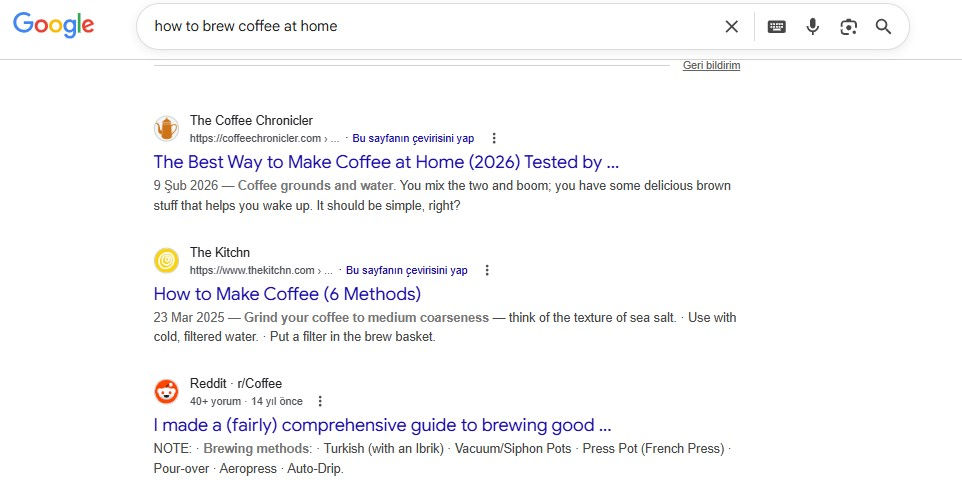
Commercial search queries often display product listings, comparisons, and shopping results, indicating that the user is closer to making a purchase decision.

Types of Search Intent
Search intent generally falls into four main categories. Understanding these categories helps businesses create content that matches what users are actually trying to achieve when they perform a search.
Informational Intent
Users with informational intent want to learn something. They may be researching a topic, trying to understand how something works, or looking for guidance on a specific subject. These searches are common when users are at the beginning of their research process.
Examples:
How to start a small business
Benefits of drinking green tea
How to train a puppy
In these cases, users expect educational content such as blog articles, guides, or explanatory resources that help them understand the topic.

Navigational Intent
Navigational searches occur when users are trying to find a specific brand, website, or platform. Instead of typing the exact website address, they search for the brand name or a particular page associated with it.
Examples:
Netflix login
IKEA website
Spotify app
In these situations, users already know where they want to go and use the search engine as a quick way to reach that destination.

Commercial Investigation
Commercial investigation searches happen when users are considering a purchase but are still evaluating their options. At this stage, people often compare products, read reviews, or look for recommendations before making a decision.
Examples:
Best noise cancelling headphones
Laptop comparison for students
Best coffee machine for home
Content that performs well for these searches often includes comparison articles, product reviews, and recommendation lists.

Transactional Intent
Transactional searches indicate that a user is ready to take action. This action could include buying a product, booking a service, or signing up for something.
Examples:
Buy running shoes online
Book a hotel in Rome
Order birthday cake online
Understanding which intent your keyword represents helps you create the right type of content for that search. When content aligns with user intent, it becomes more useful for users and more likely to perform well in search results.

4. How to Approach Keyword Research as a Beginner
Before diving into tools or keyword lists, it’s important to understand how keyword research works conceptually.
Many beginners assume keyword research simply means finding popular search terms and inserting them into content. In reality, the process is more strategic.
A structured keyword research approach typically includes three main stages:
Understanding your audience and their needs
Discovering potential keyword opportunities
Evaluating which keywords are realistic to target
For startups and smaller websites, the goal is not to immediately compete for the most competitive keywords in an industry. Instead, it is often more effective to start with specific keyword opportunities that match your expertise and audience needs.
Once a website gains authority and publishes consistent content, it becomes easier to gradually target broader search terms.
This is why many successful SEO strategies begin by focusing on smaller keyword opportunities that can realistically generate traffic.
5. A Step-by-Step Process for Choosing the Right Keywords
Once you understand the fundamentals of keyword research, the next step is applying a structured process. Below is a beginner-friendly workflow used by many SEO professionals to identify and evaluate keyword opportunities.
Step 1: Brainstorm Seed Keywords
Seed keywords are the starting point of any keyword research process. These are broad terms that describe your industry, products, services, or the main topics your business focuses on. They serve as the foundation from which more specific keyword ideas can be generated.
At this stage, the goal is not to find perfect keywords immediately, but to create an initial list of topics related to what your audience might search for. These broad keywords will later help you discover more detailed search queries and long-tail keywords.
For example, an online fitness brand might begin with topics like:
home workout routines
strength training
healthy meal plans
fitness equipment
These broad topics can then lead to more specific keyword ideas as you continue your research. A helpful way to brainstorm seed keywords is to think from your audience’s perspective. Ask yourself questions such as:
What problems does my audience face?
What solutions does my business provide?
What questions do customers frequently ask?
These types of questions often reveal valuable keyword opportunities and help you build a strong starting point for deeper keyword research.
Step 2: Use Keyword Research Tools
Keyword research tools help expand seed keywords into hundreds of related search queries. They also provide valuable data such as search volume, keyword difficulty, and related keyword suggestions, helping you identify which terms may be worth targeting in your content strategy.
Popular tools include:
Google Keyword Planner
SEMrush
Ahrefs
Ubersuggest
These tools typically provide data such as:
search volume
keyword difficulty
related keyword suggestions
competitor rankings
Using keyword research tools allows businesses to make decisions based on search data rather than assumptions.

Keyword research tools provide insights into search demand, keyword variations, and competition levels.
Step 3: Evaluate Search Volume and Keyword Difficulty
Once you have a list of potential keywords, the next step is to evaluate which ones are realistic and valuable to target. Not every keyword offers the same opportunity, so understanding key metrics helps guide better decisions.
Two important metrics when evaluating keywords are search volume and keyword difficulty.
Search volume indicates how often a keyword is searched each month. Keyword difficulty estimates how competitive it is to rank for that keyword.
Keyword | Search Volume | Difficulty |
coffee | very high | extremely competitive |
organic coffee | high | competitive |
organic coffee beans for home brewing | moderate | more realistic |
For new websites, targeting extremely competitive keywords can make it difficult to gain visibility.
Instead, focusing on keywords with moderate search demand and achievable competition levels often leads to better results and more sustainable organic growth.
Step 4: Focus on Long-Tail Keywords
Another important step in keyword research is identifying long-tail keywords. These are longer and more specific search phrases that usually reflect a clearer user need or question.
While shorter keywords often attract large search volumes, they are typically very competitive. Long-tail keywords, on the other hand, tend to be more targeted and can help websites reach users who are searching for something more specific.
Examples:
Short keyword: running shoes
Long-tail keyword: best running shoes for beginners
Short keyword: coffee maker
Long-tail keyword: coffee maker for small kitchens
Short keyword: yoga mat
Long-tail keyword: non-slip yoga mat for hot yoga
Long-tail keywords typically have:
lower competition
clearer user intent
higher conversion potential
For startups, long-tail keywords often represent one of the fastest paths to gaining organic visibility. By targeting more specific searches, businesses can reach audiences who already have a clear idea of what they are looking for, making it easier to attract more qualified traffic.

Step 5: Analyze Competitor Keywords
Competitor analysis is another valuable source of keyword ideas. By analyzing which keywords similar companies rank for, businesses can discover:
content gaps
new keyword opportunities
industry trends
SEO tools such as SEMrush and Ahrefs allow you to enter a competitor’s domain and view the keywords driving their traffic. This process can reveal keyword opportunities you might not have initially considered.

6. Tips for Choosing SEO Keywords That Actually Drive Traffic
Even with keyword data available, selecting the right keywords still requires strategic thinking. The goal is not just to find popular search terms, but to choose keywords that align with your business goals and audience needs.
Here are several practical tips to guide your decisions:
Prioritize relevance: The keyword should clearly relate to your business and the solutions you provide.
Focus on realistic competition: New websites should avoid extremely competitive keywords at the beginning.
Match search intent: Your content must answer the question or need behind the keyword.
Consider long-term content opportunities: Some keywords can evolve into entire topic clusters and support long-term content strategies.
When businesses apply these principles consistently, keyword research becomes a powerful foundation for sustainable SEO growth.
7. Takeaways: Building a Clear Keyword Strategy for Sustainable Growth
Keyword research is not just a technical SEO task. It is a strategic process that connects businesses with real user needs. By understanding search intent, evaluating keyword competition, and prioritizing long-tail opportunities, companies can create content that attracts the right audience.
For startups and growing businesses, learning how to choose keywords strategically is one of the most valuable skills in digital marketing.
A structured keyword strategy helps build visibility, authority, and long-term organic growth. It also allows businesses to plan their content more effectively and focus on topics that have real search demand. Over time, consistently targeting the right keywords helps websites gain trust from both search engines and users, making it easier to expand into new topics and reach a wider audience.
8. How DigiMinds Supports Brands in Building Data-Driven SEO Strategies
At DigiMinds, SEO strategy is developed as part of a broader digital growth approach. Instead of focusing only on individual keywords, the goal is to build structured SEO systems that connect search visibility with long-term business growth.
Through data-driven keyword research, competitor analysis, and strategic content planning, SEO opportunities are translated into scalable content and website optimization strategies. This ensures that each piece of content targets real search demand while supporting the brand’s positioning within its industry.
This approach has supported brands such as Invitro Laboratuvarı and YouWish in improving their organic visibility through structured SEO strategies and keyword-driven content planning.
By aligning keyword insights with business goals, DigiMinds helps startups and growing companies build sustainable organic growth strategies that support long-term digital performance.
9. FAQ
1. What is keyword research in SEO?
Keyword research is the process of identifying the search terms people use in search engines and optimizing content around those terms to improve visibility. It helps businesses understand what their audience is searching for and create content that matches those needs.
2. How many keywords should one page target?
Most SEO experts recommend targeting one primary keyword and several related secondary keywords per page. This approach helps maintain a clear focus while still capturing related search variations.
3. Are long-tail keywords better for beginners?
Yes. Long-tail keywords typically have lower competition and more specific search intent, making them ideal for newer websites. They also help attract more targeted visitors who are searching for something specific.
4. Which tools help with keyword research?
Common keyword research tools include Google Keyword Planner, Ahrefs, SEMrush, and Ubersuggest. These tools provide useful insights such as search volume, keyword difficulty, and related keyword suggestions.
10. Contact & Support
Effective keyword research helps businesses build stronger search visibility while connecting with audiences actively looking for their products or services. When supported by a structured SEO strategy and consistent content development, keyword research becomes a long-term growth driver rather than a one-time marketing task.
At DigiMinds, we help startups and small businesses develop data-driven SEO and content strategies, including keyword research, SEO content planning, and website optimization tailored for competitive digital markets such as the USA and Europe.
Contact us via phone at +90 507 830 2127 or email at info@digimindssolutions.com.
References:


Comments