
How to Get Your Business Mentioned in AI Search Results
- DigiMinds Solutions

- 20 hours ago
- 15 min read

As more people use AI assistants instead of traditional search engines to find products, services, and recommendations, businesses are asking a new question: How do I become one of the sources AI chooses?
There isn't a form you can submit or a setting you can enable to make ChatGPT, Google AI Overviews, Gemini, or Perplexity mention your business.
Instead, AI search tools recommend businesses they understand and trust based on the quality of their information, their authority, and their overall online presence.
In other words, the answer isn't about optimising for one specific AI tool. It's about building a website and digital presence that AI systems can confidently understand, verify, and reference.
This means combining technical SEO, helpful content, structured data, brand consistency, and online authority. Businesses that invest in these fundamentals are far more likely to appear in AI-generated answers than those relying on shortcuts or AI-specific tricks.
In this guide, you'll learn how AI search engines decide which businesses to mention, what influences AI search visibility, and the practical steps you can take to improve your chances of being recommended across ChatGPT, Google AI Overviews, Gemini, Perplexity, and other AI-powered search experiences.
1. What Is AI Search Visibility?
AI search visibility is your business's ability to be mentioned, cited, or recommended in AI-generated answers. Unlike traditional SEO, where rankings measure success, AI search visibility is about becoming a trusted source that AI systems choose to reference.
Instead of simply displaying a list of websites, AI search engines generate complete answers by analysing information from multiple sources. These systems look for businesses they can clearly understand and confidently associate with a particular topic, product, or service.
For example, if someone asks:
Who offers accounting services for small businesses?
What is the best web design agency for e-commerce businesses?
How can I improve my website's search visibility?
An AI assistant may recommend one or several businesses instead of simply listing search results.


What does it mean to appear in AI-generated answers?
Appearing in AI-generated answers means your business is mentioned, cited, or recommended when AI tools answer a user's question. Instead of relying on users to click through search results, AI systems may present your business directly within a generated response.
For example, your business may appear when someone asks:
"Which accounting software is best for small businesses?"
"What is the best dentist for dental implants in London?"
"Who offers reliable airport transfers in Antalya?"
"Which accounting firm specialises in tax services for freelancers?"
Rather than simply listing websites, AI tools generate a complete answer using information from multiple trusted sources. To decide which businesses to mention, they evaluate signals such as:
The quality and relevance of your content
Your expertise and authority within your industry
Consistent business information across the web
Mentions and citations from trusted websites
A strong technical SEO foundation and structured data
As more people use AI assistants to research products and services, being mentioned in AI-generated answers is becoming an increasingly valuable form of online visibility. It allows businesses to build trust and reach potential customers even before they visit a website.
How is this different from ranking on Google?
Traditional SEO focuses on improving your website's position within Google's search results. The goal is to rank as highly as possible so users click through to your website. AI search works differently.
Rather than asking users to choose from multiple results, AI tools generate a direct response using information they find across trusted websites and knowledge sources. Your website may influence that answer even if users never click on it.
That doesn't mean rankings no longer matter. In fact, websites with strong SEO often provide the high-quality content that AI systems rely on when generating responses.
What is GEO?
Generative Engine Optimization (GEO) refers to the practice of improving your content and online presence, so AI-powered search engines can better understand and reference your business. Rather than focusing only on keywords and rankings, GEO helps AI systems interpret who you are, what you do, and why your business is a trustworthy source.
GEO focuses on improving signals that help AI search engines understand your business, including:
A clear and consistent brand identity
Helpful content that answers real user questions
Topical expertise and authority
Structured data that explains your website
Mentions and citations across trusted websites
Consistent business information across all platforms
Rather than optimising for a single AI tool, GEO strengthens your overall digital presence so multiple AI systems can better understand and reference your business.
Is GEO replacing SEO?
GEO is not replacing SEO; it builds on it. Strong SEO creates the foundation that allows AI systems to discover, understand, and trust your website.
AI search engines still rely on many of the same signals that have always supported strong organic visibility, including:
Without these fundamentals, it's much harder for AI search engines to recognise your business as a reliable source.
As AI search continues to evolve, businesses should think of GEO as an extension of SEO rather than a replacement. Traditional SEO helps search engines find your content, while GEO helps AI systems better understand, interpret, and recommend it.
2. How Do AI Search Engines Decide Which Businesses to Mention?
AI search engines don't choose businesses at random. They evaluate multiple signals to determine whether a business is relevant, trustworthy, and authoritative enough to answer a user's question.
Unlike traditional search engines that primarily rank webpages, AI systems analyse information from multiple sources to generate a complete response. They look for businesses that consistently demonstrate expertise, provide accurate information, and have a strong presence across the web.
Rather than relying on a single ranking factor, AI search engines combine many different signals before deciding whether to mention a business.
How do AI tools understand what a business does?
AI tools build an understanding of your business by analysing your website, structured data, online mentions, and other trusted sources. The clearer and more consistent this information is, the easier it is for AI systems to identify your products, services, and expertise.
For example, AI systems look for information such as:
What products or services you offer
Which industries or locations you serve
The topics your website regularly covers
Your company's expertise and specialisations
How different pages on your website are connected
Structured data that defines your business and content
When all of these signals tell the same story, AI systems can build a much stronger understanding of your business.
Why do authority and relevance matter?
AI search engines aim to provide accurate and trustworthy answers. As a result, they are more likely to mention businesses that consistently demonstrate expertise and publish content relevant to the user's question.
Authority isn't determined by a single metric. Instead, AI systems evaluate a combination of signals, including:
Topical expertise within your industry
Mentions from reputable websites
Positive brand reputation
Consistent publishing over time
Clear evidence of experience and expertise
A business that regularly publishes useful content about a specific topic is generally more likely to be recognised than one that only mentions the topic occasionally.
Why does consistency across the web matter?
Consistency helps AI systems verify that information about your business is accurate. When your business details are the same across multiple trusted sources, AI has greater confidence in recommending your brand.
Inconsistent information can make it difficult for AI systems to determine which details are correct.
Make sure key information remains consistent across:
Your website
Google Business Profile
Social media profiles
Business directories
Industry listings
Review platforms
This includes your business name, website, phone number, email address, service descriptions, and locations.
The more consistent your digital presence is, the easier it becomes for AI systems to recognise your business as a reliable entity.
How do AI systems choose sources?
AI systems generate answers by analysing information from a variety of trusted sources rather than relying on a single website. They prioritise sources that consistently provide accurate, relevant, and authoritative information.
While each AI platform uses its own methods, they commonly evaluate signals such as:
The quality and originality of your content
Your website's authority and reputation
Structured data and technical SEO
Mentions from reputable publications
Accurate and up-to-date business information
Consistent topical expertise over time
Rather than trying to optimise for one specific AI tool, businesses should focus on becoming a trusted source of information within their industry. This increases the likelihood of being referenced across multiple AI-powered search platforms.
3. What Helps a Business Appear in AI Search Results?
There isn't a single ranking factor that determines whether AI tools mention your business. Instead, AI systems evaluate a combination of signals that help them understand, verify, and trust your brand.
Unlike traditional SEO, where rankings often depend on individual pages, AI search visibility is influenced by your entire digital presence. Your website, content, structured data, brand mentions, and online consistency all work together to help AI systems decide whether your business is a reliable source.
The following strategies can significantly improve your chances of being referenced in AI-generated answers.
Build a Clear Brand Entity
AI search engines need to understand exactly who your business is before they can confidently recommend it. Building a clear brand entity helps AI connect your business across different websites and platforms.
A brand entity is the collection of information that defines your business online. Rather than seeing your website as a series of disconnected pages, AI systems attempt to build a complete picture of your company by connecting information from multiple trusted sources.
A strong brand entity typically includes:
A clearly written About page
Consistent business name and contact details
Clearly defined products or services
Google Business Profile
Social media profiles
Author pages and company information
Structured data that identifies your organisation
The more consistent these signals are, the easier it becomes for AI systems to understand your business and confidently reference it when answering relevant questions.
Keep Your Business Information Consistent
AI systems trust businesses whose information is consistent across the web. Conflicting business details make it harder for AI to verify which information is accurate.
Your business information should match everywhere it appears online. Even small differences in your company name, address, phone number, or service descriptions can reduce confidence in your business.
Review and regularly update your information across:
Your website
Google Business Profile
Business directories
Social media platforms
Industry listings
Review websites
Consistency doesn't directly improve rankings, but it strengthens the trust signals that both search engines and AI systems use to evaluate your business.

Create Content That Directly Answers Real Questions
AI search engines favour content that provides clear, direct answers to real user questions. Pages that immediately address search intent are easier for AI systems to understand and reference.
Instead of writing content only around keywords, create content that solves problems and answers the questions your audience is already asking.
Helpful content often includes:
Question-based headings
Direct answers at the beginning of each section
Step-by-step explanations
Examples and comparisons
Frequently asked questions
Original insights based on experience
This approach benefits both traditional SEO and AI search because it improves readability while making key information easier for AI systems to extract.
Demonstrate Experience and Expertise
AI search engines are more likely to reference businesses that consistently demonstrate real experience and expertise. Content that reflects first-hand knowledge is generally more valuable than generic information that could apply to anyone.
As AI systems become better at evaluating content quality, they look beyond keywords and consider whether your website provides genuine value. Businesses that regularly publish original insights, practical advice, case studies, and expert guidance are more likely to be recognised as trustworthy sources.
You can demonstrate experience and expertise by:
Publishing in-depth articles based on real-world knowledge
Sharing case studies and project examples
Including author names and professional credentials
Keeping content accurate and up to date
Supporting claims with reputable sources where appropriate
Creating content that solves real customer problems
The goal isn't simply to publish more content; it's to create content that shows why your business is qualified to answer questions in your industry.

High-quality content written by recognised authors helps establish experience, expertise, and credibility for both search engines and AI systems.
Build Strong Topic Authority
AI systems don't evaluate individual pages in isolation. They look for businesses that consistently publish high-quality content around a specific topic over time.
Topic authority is built when your website covers a subject comprehensively instead of relying on a single article. The more helpful and interconnected your content is, the easier it becomes for AI systems to recognise your business as a reliable source within that area.
For example, an accounting firm could publish content covering:
Tax planning
Bookkeeping
Payroll services
VAT regulations
Financial reporting
Small business accounting
Together, these articles demonstrate expertise across the broader topic rather than focusing on just one keyword.
Building topic authority also involves:
Creating related content clusters
Linking relevant articles together
Updating older content regularly
Covering beginner and advanced questions
Publishing consistently over time
Strong topic authority increases the likelihood that AI systems associate your business with the subjects you want to be known for.

Publishing multiple high-quality articles around the same topic helps search engines and AI systems recognise your website as an authoritative source.
Earn Mentions and Citations Across Trusted Websites
AI search engines don't rely solely on your website. They also consider how your business is referenced across other trusted websites when evaluating credibility.
When reputable publications, industry websites, business directories, and review platforms mention your company, they provide additional signals that help AI verify your business and its expertise.
Examples of valuable mentions include:
Industry publications
News websites
Professional associations
Trusted business directories
Partner websites
Customer review platforms
Guest articles on reputable websites
Quality matters far more than quantity. A few mentions from respected sources often provide stronger trust signals than dozens of low-quality backlinks or directory listings.
Rather than trying to collect links for SEO alone, focus on building a credible online reputation that demonstrates your business is recognised within its industry.


Use Structured Data to Clarify Your Business
Structured data helps AI systems understand your business by providing clear, machine-readable information about your website. While it doesn't guarantee AI mentions, it makes it easier for search engines and AI tools to accurately interpret your content.
Instead of relying only on visible text, structured data explains important details such as who owns the website, what services are offered, who wrote an article, and how different pages are connected. This reduces ambiguity and helps AI systems build a clearer understanding of your business.
Some of the most valuable schema types for AI search include:
Organization Schema to identify your business
Service Schema to define the services you offer
Article Schema to describe blog content
Person Schema to connect authors with their expertise
FAQ Schema to organise common questions and answers
Breadcrumb Schema to explain your website structure
Structured data works alongside high-quality content and technical SEO. When all of these signals align, AI systems have more confidence in interpreting your website correctly.
If you'd like to learn more about implementing structured data, read our complete guide to What Is Schema Markup and How Does It Help Search Engines and AI Understand Your Business?

4. Does Traditional SEO Still Matter for AI Search?
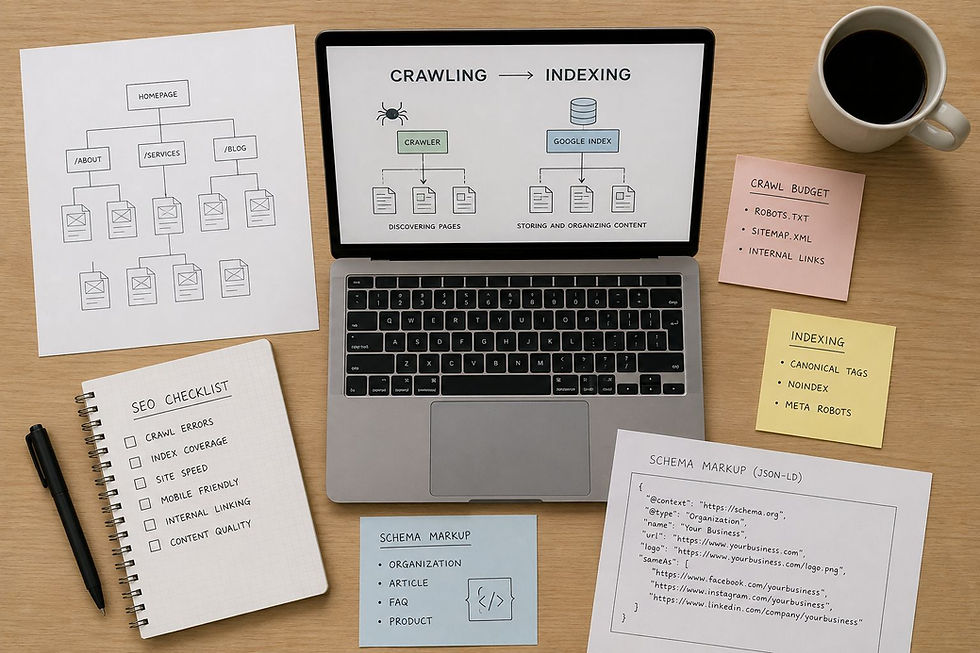
Traditional SEO is still the foundation of AI search visibility. AI tools can only understand and recommend content that search engines are able to discover, crawl, index, and trust.
Many businesses assume that AI search requires an entirely new optimisation strategy. In reality, the fundamentals of SEO remain just as important. GEO builds on these foundations rather than replacing them.
Before AI systems can reference your business, your website should already follow SEO best practices, including:
Crawlable and indexable webpages
A clear website structure and internal linking
Helpful, people-first content
Fast loading speeds and a mobile-friendly experience
Accurate metadata and descriptive page titles
High-quality backlinks and trusted brand mentions
Structured data that provides additional context
Think of traditional SEO as building the foundation of a house. GEO adds another layer by helping AI systems better understand and connect the information you've already published.
Businesses that neglect technical SEO often struggle with AI visibility because their content is harder to discover, interpret, and verify. On the other hand, websites with strong SEO foundations are better positioned to benefit as AI-powered search continues to evolve.
Rather than choosing between SEO and GEO, businesses should invest in both. Strong SEO improves discoverability, while GEO increases the likelihood that AI systems will understand and reference your business in generated answers.
5. Can You Track Whether AI Tools Mention Your Business?
Tracking AI search visibility is possible, but it works differently from monitoring traditional SEO rankings. While there isn't a dedicated tool that shows every AI mention, you can monitor several indicators that reveal whether your business is becoming more visible across AI-powered search.
Unlike Google Search, AI platforms don't provide a ranking report or dashboard showing when your business appears in generated answers. Instead, businesses should monitor a combination of search performance, brand visibility, and AI-generated responses.
Some practical ways to measure AI search visibility include:
Searching for your business using AI tools such as ChatGPT, Google AI Overviews, Gemini, and Perplexity
Monitoring branded search queries in Google Search Console
Tracking growth in organic traffic to informational content
Monitoring brand mentions across trusted websites
Checking whether your content appears in AI-generated citations when available
Watching for increases in referral traffic from AI-powered search experiences
Remember that AI visibility is not a single metric. It's the result of consistently building authority, publishing helpful content, and strengthening your online presence over time.
6. Common GEO Mistakes
Many businesses focus on AI tools themselves instead of improving the signals AI systems rely on. In most cases, poor AI visibility is the result of weak SEO fundamentals rather than a lack of AI-specific optimisation.
Avoid these common mistakes when building AI search visibility:
Publishing generic content that doesn't provide original value
Chasing keywords instead of answering real customer questions
Ignoring technical SEO and website performance
Having inconsistent business information across platforms
Publishing content without demonstrating expertise or experience
Neglecting structured data and schema markup
Covering too many unrelated topics instead of building topical authority
Expecting immediate results from AI optimisation
Rather than looking for shortcuts, focus on creating a trustworthy website that consistently demonstrates expertise, authority, and relevance. These are the signals that both search engines and AI systems value most.
7. How Long Does It Take to Build AI Search Visibility?
Building AI search visibility is a long-term process. Most businesses won't see immediate results because AI systems need time to discover, understand, and build confidence in your website and brand.
The timeline depends on factors such as your website's existing authority, the quality of your content, your technical SEO, and how consistently you strengthen your online presence.
A typical progression might look like this:
Timeframe | What Typically Happens |
Month 1 | Technical improvements, structured data implementation, and content optimisation. |
Months 2–3 | Search engines recrawl content, rankings begin to improve, and topical authority starts to grow. |
Months 3–6 | Brand mentions, backlinks, and content depth strengthen your online authority. |
6+ Months | AI systems have a clearer understanding of your business, increasing the likelihood of being referenced in relevant AI-generated answers. |
The most successful businesses treat AI visibility as an ongoing investment rather than a one-time project. Publishing helpful content, maintaining technical SEO, and building authority over time will continue to strengthen your presence across both traditional search and AI-powered search.
8. Key Takeaways: How to Get Your Business Mentioned in AI Search Results
Getting your business mentioned in AI-generated answers isn't about optimising for a single AI platform. It's about building a strong digital presence that both search engines and AI systems can understand, verify, and trust.
The most important points to remember are:
AI search visibility is built on top of traditional SEO, not instead of it.
Create helpful, people-first content that directly answers your audience's questions.
Build a clear and consistent brand entity across your website and trusted third-party platforms.
Demonstrate genuine experience and expertise through original, high-quality content.
Strengthen topical authority by covering your industry comprehensively over time.
Use structured data to help search engines and AI systems better understand your business.
Earn mentions and citations from reputable websites to reinforce trust and credibility.
Focus on long-term consistency rather than quick AI optimisation tactics.
As AI-powered search continues to evolve, businesses that invest in these fundamentals will be better positioned to increase their visibility across both traditional search engines and AI-generated search experiences.
9. How DigiMinds Helps Businesses Build Visibility Across Search and AI
Building visibility in AI search requires more than publishing content or adding structured data. It takes a strong SEO foundation, helpful content, a clear website structure, and a trusted online presence that both search engines and AI systems can understand.
At DigiMinds Solutions, we help startups, small businesses, and growing brands improve their visibility across both traditional search engines and AI-powered search. Our approach combines technical SEO, content strategy, entity optimisation, structured data, and ongoing website improvements to strengthen your online presence and build long-term search performance.
Rather than focusing on quick fixes or short-term tactics, we help businesses create a digital foundation that supports sustainable growth and increases the likelihood of being discovered, understood, and recommended as search continues to evolve.
10. FAQ
1. Does ChatGPT automatically find every business on the internet?
No. AI tools don't automatically include every business in their responses. They rely on publicly available information and evaluate signals such as content quality, authority, structured data, and consistency before referencing a business.
2. Can small businesses appear in AI-generated answers?
Yes. AI systems don't only reference large brands. Small businesses that publish helpful content, demonstrate expertise, and build a strong online presence can also be mentioned in AI-generated responses.
3. Does publishing more content improve AI visibility?
Not necessarily. Publishing a large number of articles is less important than consistently creating high-quality content that answers real user questions and demonstrates expertise within your industry.
4. Do AI search engines use structured data?
Structured data helps AI systems better understand your business and website. While it doesn't guarantee AI mentions, it provides additional context that supports search engines and AI-powered search.
5. Can paid advertising improve AI search visibility?
Paid advertising doesn't directly influence whether AI tools mention your business. AI visibility is primarily driven by the quality, authority, and trustworthiness of your website and broader online presence.
6. How often should I update my website for AI search?
Regularly updating your website with accurate information, fresh content, and ongoing technical improvements helps maintain both traditional search performance and AI search visibility over time.
7. Do I need to optimize my website for every AI platform?
No. You don't need a separate strategy for ChatGPT, Gemini, Perplexity, or other AI tools. Instead, focus on creating a strong SEO foundation, publishing helpful content, building authority, and maintaining consistent business information. These best practices benefit your visibility across multiple AI-powered search platforms.
11. Contact & Support
Building visibility in AI search is an ongoing process that combines technical SEO, high-quality content, structured data, brand authority, and a consistent online presence. Businesses that invest in these foundations are more likely to be understood, trusted, and recommended by both search engines and AI-powered search platforms.
At DigiMinds Solutions, we help startups, small businesses, and growing brands develop future-ready SEO strategies that improve visibility across Google Search, AI search engines, and emerging search experiences. From technical SEO and entity optimisation to content strategy and structured data implementation, our goal is to help your business build long-term organic growth.
Contact us at +90 507 830 2127 or info@digimindssolutions.com to discuss your SEO goals and discover how a tailored AI search and technical SEO strategy can help your business stand out in the future of search.
References:


Comments